
For bedrooms and darker rooms
Blackout blinds in Wigan
Blackout fabric stops the light. Side channels stop it creeping round the edges. Made to measure for bedrooms across Wigan.

Ways to black out:
Get in touch
Let’s talk about your blinds
Quick enquiry
Request a call back
Choosing blackout
What matters most?
The fabric is half the job; the rest is how closely the blind fits.
Your options
Ways to make a room dark
Choose a tab to see how each one works, how dark it gets and where it suits.

Cassette blackout blinds with side channels
For an ordinary window, this is the darkest kind of blind. The fabric rolls into a slim cassette at the top and runs down a channel at each side, and the bottom bar meets the sill or the frame, so light has very little way round it.
Depending on the system, it fits to the frame or in the recess, and works by spring, by motor or by a chain held by its safety device.
Good for
- Bedrooms
- Children’s rooms
- Night workers
- Blackout fabric
- A channel at each side
- Cassette at the top, a seal at the bottom
- Light at the edges
- Very little
Perfect Fit blackout blinds
A Perfect Fit blind sits in a slim frame that clips into the glazing bead of a uPVC window or door, with no drilling. Held close to the glass, it leaves only small gaps, and it moves with the window when you open it.
It needs a suitable bead, which we check when we measure. Ask us which Perfect Fit styles come in blackout.
Good for
- uPVC windows
- Tilt-and-turn windows
- Glazed doors
- No drilling into the frame
- Moves with the window
- Needs
- A suitable glazing bead
Blackout roller blinds
The simplest way to darken a room. No light passes through the fabric, though some still finds its way round the sides, top and bottom.
How much depends on the fitting: inside the recess there’s a thin gap at each side, while a blind on the wall above can overlap the recess and cover more of the edges.
Good for
- Bedrooms
- TV rooms
- Blackout fabric
- In the recess or on the wall
- Light at the edges
- Some; less when it overlaps
Roman blinds with a blackout lining
For the softness of fabric at a bedroom window, a Roman blind with a blackout lining darkens the room and still gathers into soft folds when it’s raised.
Like any blind hanging in front of the window, it lets some light show at the edges: a dark, cosy room rather than total darkness.
Good for
- Bedrooms
- Guest rooms
- Living rooms
- Blackout lining
- Soft folds when raised
- Light at the edges
- Some, as with any hanging blind

Patio doors and wide glazing
Wide windows and runs of doors usually take two or more blinds side by side, and a thin line of light can show where they meet, as in the photograph.
On doors you open every day, a blind on the door itself moves with it: a Perfect Fit blind on uPVC doors, or a blind on each panel of bi-fold doors. For wide or high glass, a motor can raise several blinds with one remote.
Good for
- Patio doors
- Bi-fold doors
- Open-plan rooms
- Blinds side by side
- A blind on each door
- Where blinds meet
- A thin line of light

Blackout for gable and shaped windows
In a loft bedroom, an apex window lets in the first light of a summer morning. Blackout fabric made to the shape of the glass, with matching blinds on the doors below, makes the room dark enough to sleep. A little light still shows at the edges, as the photograph shows.
Good for
- Loft bedrooms
- Apex windows
- Blackout fabric in a shape
- Matching blinds for the doors below
- Light at the edges
- A little, depending on the window
How dark is dark?
Where light gets in
Blackout fabric lets no light through. Whether the room goes fully dark depends on four other places.
Round the sides
A thin gap at each side, closed by side channels or a blind that overlaps the recess.
Over the top
Light spills over the roller unless a cassette covers it.
Under the bottom
A bottom bar that meets the sill stops the strip of light below.
Where blinds meet
Two blinds side by side leave a narrow join.
Our work
Bedrooms we’ve dressed
A blackout roller, and three other ways we’ve dressed bedrooms around Wigan.
-

Blackout roller in a bedroom -

Charcoal Roman in a bedroom -

Dark venetian in a bedroom -
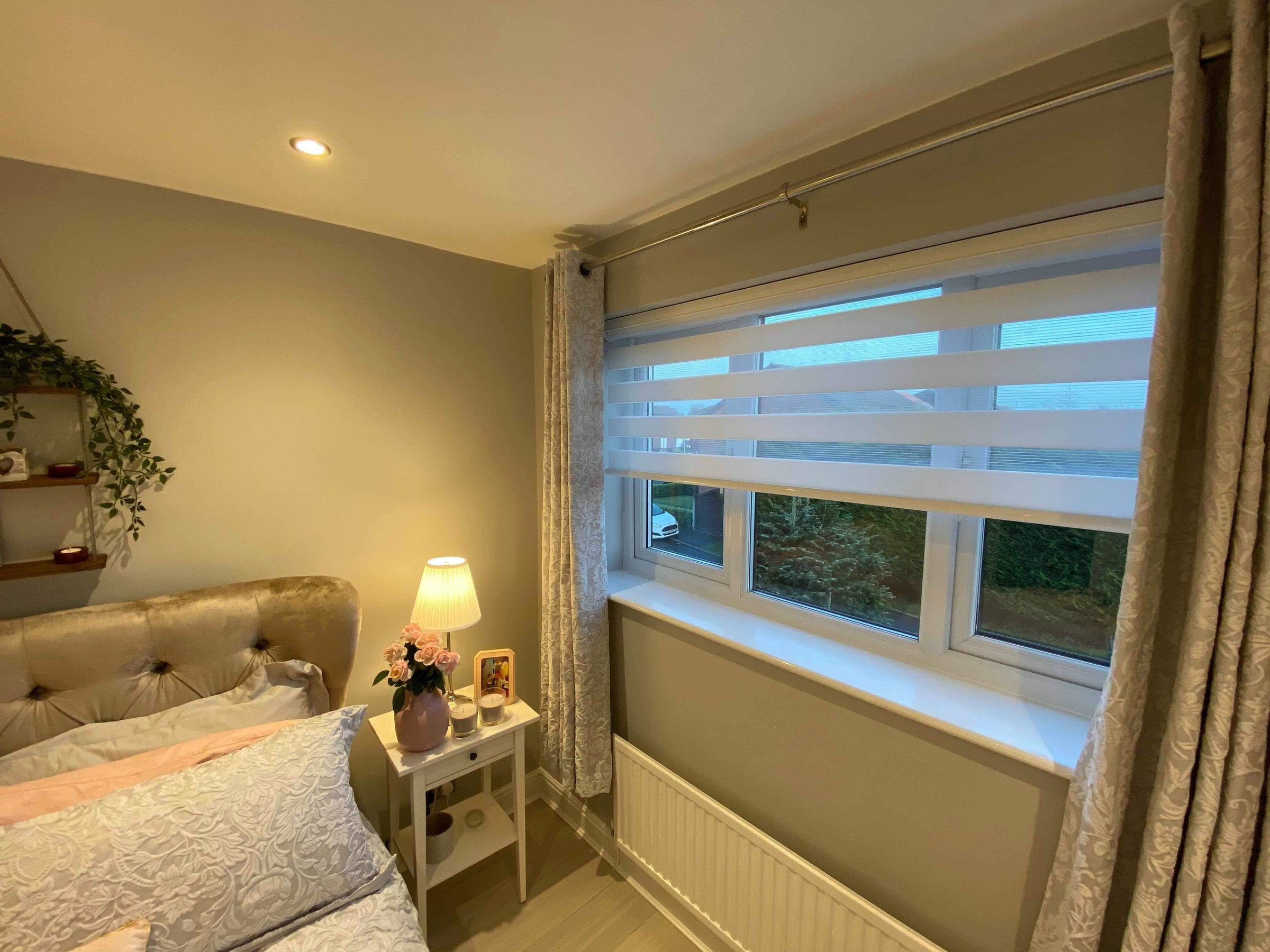
Day-and-night in a bedroom


Questions
Blackout blinds: your questions answered
Much darker, and close to dark with the right blind. The fabric lets no light through, so the edges decide the rest; we’ll tell you what to expect at your window.
Blackout fabric is made so that light doesn’t pass through it. Dim-out lets a little through and takes the glare off a room, but won’t make it dark. For sleep, choose blackout.
No. “Blockout” is another word for the same thing; what matters is the fabric and how the blind fits the window.
A cassette blackout blind with side channels, because it covers the edges as well as the glass. Next come a Perfect Fit blind in blackout fabric and a blackout roller that overlaps the recess.
On many uPVC windows and doors, yes: a Perfect Fit blind clips into the glazing bead, so nothing is drilled into the frame. We check your windows have a bead that will take one.
One dark enough for daytime naps, ideally with nothing to pull: a spring or motorised blind has no chain. Any blind with a chain comes with a safety device, which should be fitted. Keep cots and beds away from the window.
Yes. Each window of the bay gets its own blind, made to its own size, so the whole bay can be closed off. A little light can show where the blinds meet at the corners.
Dust it with a soft brush or a vacuum on low, and spot-clean marks with a damp cloth. Don’t soak or fold blackout fabric: creases can let light through.
It depends on the size and number of windows, the kind of blind, the fabric and how you’d like to work it. We measure at a free home visit and then give you a clear quote, with no obligation.
Sleep in a darker room
Book a free home consultation anywhere in and around Wigan. We’ll measure every window, tell you how dark each one can get and give you a no-obligation quote.