
Gable and apex windows
Gable end and apex blinds
A gable window is the showpiece of a room, and the hardest one to dress. Our blinds follow its angles, so the apex can be shaded or darkened.

Shaped to fit:
Get in touch
Let’s talk about your gable blinds
Quick enquiry
Request a call back
Gable blinds
What it’s for
A standard blind can’t follow the sloping sides of an apex. A shaped one can, so start with what you need the window to do.
Your options
Choosing blinds for a gable window
The fabric, how the blind works and what goes beneath it. We’ll go through each at your consultation.


Shaped pleated blinds
Pleated fabric is made in the shape of the glass, so it follows the slope of the roof right into the corners. A light-filtering fabric softens the sun and keeps the room bright, so a gable living room still feels open while the glare is gone.
The same fabric on the doors or windows below makes the whole wall read as one.
Think about which way the gable faces. A south or west-facing apex catches strong afternoon and evening sun, which is when a shaped blind earns its keep; a north-facing one may only need privacy after dark.
Good for
- Vaulted living rooms
- Kitchen-diners
- Garden rooms
- Made to the exact shape
- Light-filtering fabrics
- Matching blinds for the doors below
- Shapes
- Triangle, tapered or angled
- Fabrics
- Light-filtering or dim-out


Blackout gable blinds for bedrooms
In a loft bedroom, the apex can let in the first light of a summer morning. Blackout fabric, shaped to the apex and the glass below, makes the room dark enough to sleep.
Because the blinds are shaped and fitted within the frame, a little light can still show at the edges; how much depends on the window, and we’ll tell you what to expect.
Good for
- Loft bedrooms
- Guest rooms
- Rooms with a TV
- Blackout fabric in a shape
- Apex and doors to match
- Honest about light at the edges
- Fabric
- Blackout
- Light at the edges
- A little, depending on the window
Fixed or opening apex blinds
The angled part of a gable window can have a fixed blind that always covers the apex, set in place to its shape. It’s simple and neat, and there’s nothing to reach.
Or it can open, so you can have the full view of the sky when you want it, gathering back along the sloping edges as in the photograph at the top of this page. Below the apex, blinds on the doors and windows raise and lower as usual. Which works for you depends on the window and the height, and we’ll show you the choices.
A fixed apex blind still lets light through a light-filtering fabric, so the room stays bright; it simply stops the glare and the view in from outside.
Good for
- High apex windows
- Rooms where the view matters
- Fixed: always covering, nothing to reach
- Opening: the full view when you want it
- Blinds below work as normal
- Apex
- Fixed or opening
- Below
- Raise and lower as usual

Blinds for the doors beneath
Most gable windows sit above bi-fold or sliding doors. Bi-folds need a blind on each glass panel that folds back with the doors, and pleated blinds on the doors can match the apex exactly.
For sliding doors, a blind above the opening that raises clear of the glass works well, as the loft bedroom photographs show.
Planning the apex and the doors at the same visit means one set of measurements, one fabric choice and blinds that line up across the whole wall.
Good for
- Bi-fold doors
- Sliding doors
- French doors
- A blind on each glass panel for bi-folds
- Fabric to match the apex
- Raises clear of sliding doors
- Bi-folds
- A blind on each panel
- Sliding doors
- A blind above the opening
Working blinds high up
The top of a gable can be well out of reach. For a blind that opens, a pole from the floor or a motor with a remote means you never need a ladder.
Where there are children, cord-free or motorised blinds keep the window clear; any blind with a cord or chain comes with a safety device, which should be fitted.
We’ll talk it through with you at the window, with the height in front of us.
Good for
- High gables
- Family rooms
- Pole or motor for an opening blind
- No ladder needed
- Cord-free choices for family rooms
- Control
- Fixed, pole or motor
- Child safety
- Cord-free, or the chain held by its safety device
Side by side
Light-filtering or blackout?
The two fabrics from the tabs above, and what goes with either.
| Shaped pleated | Blackout | |
|---|---|---|
| Fabric | Light-filtering or dim-out | Blackout |
| Shapes | Triangle, tapered or angled | Shaped to the apex and the glass below |
| Suits | Vaulted living rooms, kitchen-diners | Loft bedrooms, guest rooms |
| Light at the edges | A little, depending on the window | |
| The apex | Fixed or opening | Fixed or opening |
| The doors beneath | Matching blinds | Matching blinds |
| Working them | Fixed, pole or motor | Fixed, pole or motor |
Options depend on the fabric and window; we’ll confirm at your consultation.
Before you choose
From measuring to fitting
If you’re building an extension or converting a loft, it helps to think about the blinds while the glazing is being chosen: the depth of the frames and the position of handles and glazing bars all affect how a shaped blind sits, and what can open.
01
Every angle and length matters, so we measure the glass at your home. You don’t need to measure anything.
02
Light-filtering to soften the sun in a living room, or blackout for a bedroom.
03
A fixed apex blind has nothing to reach. An opening one works by pole or by motor.
04
We fit the apex and the doors beneath, check each blind sits neatly in the frame and works as it should, and show you how to use them.
05
Dust pleated fabric with a soft brush and spot-clean marks; don’t soak it, or the pleats lose their shape.
Other shapes
Bays, arches and circles too
Not every awkward window is a gable. A few other shapes we’ve supplied and fitted.
-

A sunburst for a round window -

Verticals round a curved bay -

Perfect Fit blinds in a bay -
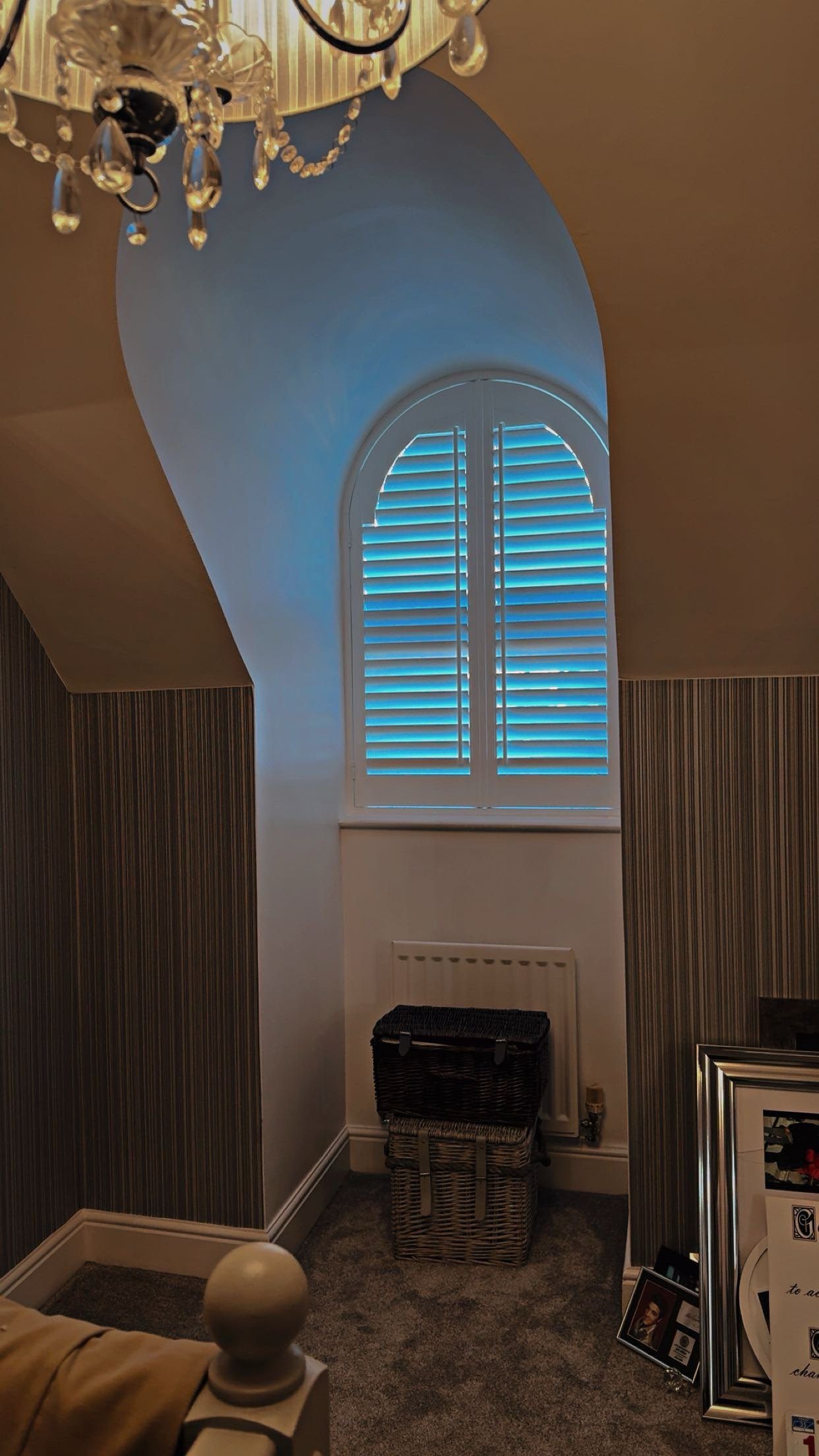
Shutters for an arched window


Questions
Gable end blinds: your questions answered
A blind made to the shape of a gable or apex window, usually a triangle or a tapered panel, so it follows the sloping sides of the glass instead of leaving them bare.
Either, depending on the window. A fixed blind always covers the apex; an opening one gathers back so you have the full view when you want it. We’ll show you what’s possible for yours.
Yes, with blackout fabric shaped to the apex and the glass below. A little light can still show at the edges of a shaped blind, and we’ll tell you what to expect at your window.
Most people choose pleated, since it can be cut to a shape and still folds up tidily. Pick a light-filtering one to soften the sun in a living room, or blackout for a bedroom.
With a pole from the floor, or a motor worked by a remote or from your phone with a smart hub.
Yes. Blinds on bi-fold or French doors can be made in the same fabric as the apex, so the wall looks like one design. Sliding doors can have a blind above the opening that raises clear of the glass.
That’s common, and it’s why every blind is made to measure. We take each angle and length at your window, so the blind follows its real shape rather than a standard triangle.
It takes care, because every angle matters. We measure each one at your home, which is part of the free consultation, so you don’t need to measure anything yourself.
Yes. Angled windows can take shaped Perfect Fit blinds, and round or arched windows can have shutters made to their shape. See shutters for shaped windows, and for a glass roof, roof blinds.
Choose cord-free or motorised blinds where children are about. Any blind with a cord or chain comes with a safety device to hold it out of reach, and it should be fitted. A fixed apex blind has no cord at all.
Let’s dress your gable window
Book a free home consultation anywhere in and around Wigan. We’ll measure every angle and give you a no-obligation quote.